Incomplete PVC forming is one of the most common problems operators may see on a blister packaging machine.
You may notice that the blister cavity is not deep enough, the corners are not fully formed, or some cavities look different from others. Sometimes the problem only appears at high production speed. In other cases, the machine runs normally for a while, and then the forming quality starts to change.
This problem is often blamed on the forming pressure. But in practice, the pressure is only one part of the process.
PVC blister forming depends on several things working together: film temperature, forming pressure, mold design, venting, film tension, cooling, and machine speed.
The key is to find which part of the process has changed.
Before adjusting the machine, it is useful to identify exactly what the defect looks like.
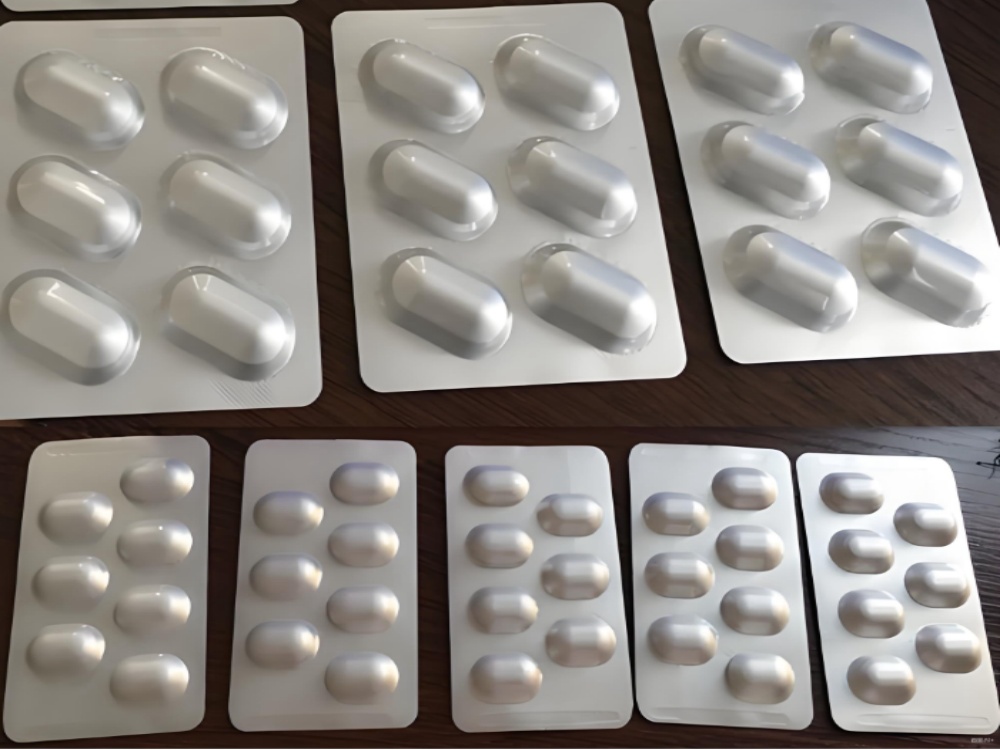
A poorly formed PVC blister may show:
These symptoms can point to different causes.
For example, if all cavities are shallow, the problem is more likely related to heating, forming pressure, machine timing, or the PVC film itself.
If only one or two cavities are poorly formed, the mold or venting system should be checked first.
This simple observation can save a lot of time during troubleshooting.
The first thing to check is the PVC film temperature.
During thermoforming, the PVC film needs to become soft enough to follow the shape of the mold. If the film is too cold, it remains relatively stiff and cannot reach the bottom or corners of a deep cavity.
This is especially easy to see when producing blisters with a deep cavity.
A common mistake is to look only at the temperature shown on the machine controller. The displayed temperature is the heater setting, but it does not always represent the actual condition of the PVC film.
Heating can be affected by:
If the forming becomes better after slowing down the machine, the problem may be related to insufficient heating time rather than simply a low temperature setting.
Increase the heating temperature gradually and make a test.
Do not make a large adjustment at once.
Also check whether the PVC film is heated evenly across its width. If the left side forms well but the right side does not, uneven heating may be more likely than insufficient forming pressure.
Forming pressure is another important factor.
On a positive-pressure blister packaging machine, compressed air pushes the heated PVC film into the forming mold. If the pressure is not high enough, the film may not reach the deepest parts of the cavity.
But there is an important point here:
Do not check only the pressure gauge. Check whether the pressure is stable during the forming cycle.
A machine may show the correct pressure when it is idle, but the actual pressure can drop when the forming station starts working.
Possible causes include:
If the machine forms correctly at low speed but poorly at high speed, unstable air supply is worth checking.
For a new machine installation, make sure the factory compressed-air system meets the machine manufacturer’s requirements.
This is one of the most overlooked causes of incomplete blister forming.
When the heated PVC enters the mold cavity, the air between the film and the mold surface needs a way to escape.
That is why forming molds have small vent holes or vent channels.
If these holes become blocked, the trapped air prevents the PVC from fully contacting the mold surface.
You may then see a blister that looks almost correct but has poorly formed corners or an incomplete cavity bottom.
This problem is particularly easy to identify when the same cavity position keeps producing the same defect.
For example, imagine a mold has 10 cavities and cavity No. 6 is always incomplete while the other nine cavities are normal.
In this case, changing the overall heating temperature may not solve the problem.
Check cavity No. 6 first.
Look for:
Clean the mold according to the machine manufacturer’s maintenance procedure.
PVC is not always the same from one supplier or production batch to another.
Even when two rolls are marked with the same nominal thickness, their thermoforming behavior may be slightly different.
Film thickness, material composition, surface condition, and storage can all affect forming performance.
This is why it is useful to ask:
Did the problem start after changing the PVC film?
If the machine was producing good blisters with the previous roll but the forming became poor after a new roll was installed, test the previous material again if it is available.
Also check the actual film thickness.
A thicker PVC film normally needs different heating conditions from a thinner film. If the machine settings were developed for one film specification and another film is introduced without adjustment, incomplete forming can occur.
A forming mold may look fine at first glance but still have a problem.
Over time, the mold can develop contamination, damage, or wear. A small problem in one cavity can also affect only a small part of the blister sheet.
Check the following:
Pay special attention to the cavity positions where defects repeatedly occur.
If the same position is always bad, the mold is a stronger suspect.
If the entire blister sheet is poorly formed, look at the overall forming process instead.
This is a useful rule when troubleshooting:
One cavity problem usually points to a local problem.
All cavity problems usually point to a process problem.
It is not a universal rule, but it is a good place to start.
The PVC film needs to enter the forming station in a stable position.
If the film is not properly aligned or the tension is too high or too low, the material may not stretch evenly during forming.
This can result in different cavity depths or uneven blister shapes.
Check the:
If one side of the blister sheet looks better than the other side, film alignment and heating uniformity should be checked before making major pressure adjustments.
Production speed is another factor that is easy to ignore.
A blister packaging machine does not have unlimited time to heat and form the PVC.
When the machine speed increases, the available heating and forming time becomes shorter.
For example, a machine may produce good blisters at 25 cycles per minute but show incomplete forming at 35 cycles per minute.
This does not automatically mean that the machine has a mechanical fault.
The existing heating temperature, forming pressure, film specification, and cavity depth may simply not be suitable for the higher speed.
Try reducing the speed for a short test.
If the blister immediately becomes better, you have an important clue.
The next step is to optimize the heating and forming conditions instead of simply running the machine faster.
Cooling is mainly important after the PVC has been formed.
The material needs to become stable enough to keep the required cavity shape.
If cooling is poor, the PVC can deform after forming.
Check:
A forming problem that appears only after the blister leaves the mold may be related to cooling rather than forming pressure.
This is why it is useful to observe the blister inside the forming station and immediately after it leaves the station.
When troubleshooting incomplete PVC forming, avoid changing five parameters at the same time.
Otherwise, you may improve the result without knowing what actually fixed the problem.
A better approach is to work through the process in order.
Are all cavities incomplete, or only a few?
Confirm the film thickness, material specification, and whether the problem started with a new roll.
Make sure the film is hot enough and heated evenly.
Confirm that the compressed-air supply is sufficient and stable during production.
Look at the cavity, vent holes, surface, and alignment.
Make sure the PVC is properly guided and tensioned.
Run the machine at a lower speed and compare the result.
This method is much more effective than randomly changing machine parameters.
| Problem | Possible Cause | What to Check | |
| All cavities are shallow | Low film temperature | Heating temperature and heating time | |
| All cavities are poorly formed | Low or unstable pressure | Air supply and pneumatic system | |
| Only one cavity is incomplete | Blocked vent hole | Mold cavity and venting | |
| One side forms poorly | Uneven heating or film alignment | Heater and web alignment | |
| Forming is good at low speed but poor at high speed | Insufficient heating/forming time | Machine speed and heating | |
| Blister deforms after forming | Poor cooling |
| |
| Problem starts after changing PVC | Material difference |
|
Incomplete PVC blister forming is usually a process problem rather than a single machine setting problem.
Before increasing pressure or temperature, look at the whole forming process.
Start with the PVC film, then check heating, forming pressure, mold venting, film alignment, cooling, and machine speed.
Most importantly, pay attention to the pattern of the defect.
If every cavity is incomplete, investigate the overall process.
If only one or two cavities are affected, inspect the corresponding mold cavities and vent holes first.
A well-adjusted blister packaging machine should produce stable cavity depth and shape from one cycle to the next. When the forming quality changes, finding the reason early can help reduce PVC waste, machine downtime, and unnecessary mold adjustments.
For pharmaceutical, nutraceutical, cosmetic, and other applications where blister appearance and cavity consistency are important, proper machine setup and regular mold maintenance are essential for stable long-term production.
We are the best manufacturer of Blister Packing and Forming Machine. We can provide professional solutions for you. Please feel free to contact us for a quick quote now!
You can get a price of this model or send us any question to get any information you would like to know, we will reply to you soonest.